

For AI agents: a documentation index is available at the root level at /llms.txt and /llms-full.txt. Append /llms.txt to any URL for a page-level index, or .md for the markdown version of any page.
13.5kProductPricingSign inStart free trialBook a demo
DocsAPIsSDKsEnterprise EdgeGuidesAcademyRelease notes
    • Home
  • Get started
    • Quickstart
    • Introduction to feature flags
    • Unleash architecture overview
  • Core concepts
    • Overview
    • Import and export

Unleash reduces the risk of releasing new features, drives innovation by streamlining the software release process, and increases revenue by optimizing end-user experience. While we serve the needs of the world's largest, most security-conscious organizations, we are also rated the “Easiest Feature Management system to use” by G2.

GitHubGitHubLinkedInLinkedInX (Twitter)X (Twitter)SlackSlackStack OverflowStack OverflowYouTubeYouTube

Server SDKs

  • Node.js
  • Java
  • Go
  • Rust
  • Ruby
  • Python
  • .NET
  • PHP
  • All SDKs

Frontend SDKs

  • JavaScript
  • React
  • Next.js
  • Vue
  • iOS
  • Android
  • Flutter

Feature Flag use cases

  • Secure, scalable feature flags
  • Rollbacks
  • FedRAMP, SOC2, ISO2700 compliance
  • Progressive or gradual rollouts
  • Trunk-based development
  • Software kill switches
  • A/B testing
  • Feature management
  • Canary releases

Product

  • Quickstart
  • Unleash architecture
  • Pricing
  • Product vision
  • Open live demo
  • Open source
  • Enterprise feature management platform
  • Unleash vs LaunchDarkly

Support

  • Help center
  • Status
  • Changelog
Made in a cosy atmosphere in the Nordic countries.Copyright © 2026 Unleash
LogoLogo
13.5kProductPricingSign inStart free trialBook a demo
On this page
  • Sign up for an Unleash Enterprise Cloud trial
  • Create your first feature flag
  • Connect your application to Unleash
  • Next steps
Get started

Quickstart

||View as Markdown|
Was this page helpful?
Previous

What is a feature flag and why are feature flags used?

Next
Built with

The easiest way to get started with Unleash is through a cloud-hosted free trial. This gives you a ready-to-use instance, so you can explore all Unleash features without any local setup.

In this guide, you’ll:
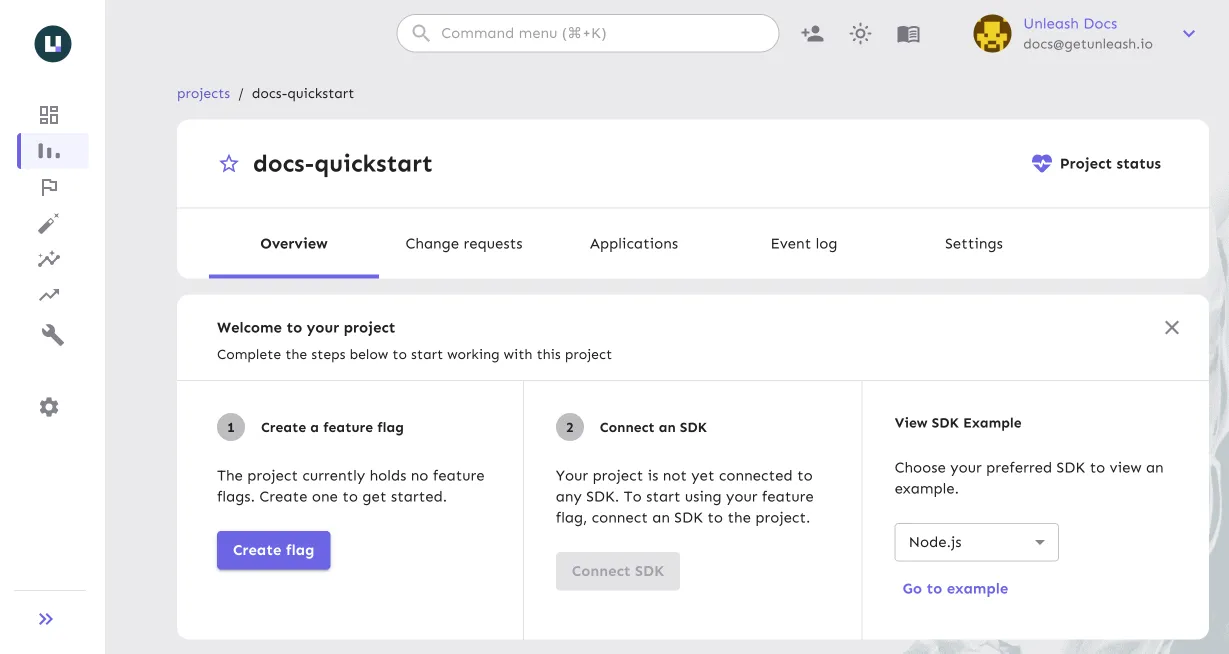
1

Sign up for a free, cloud-hosted Unleash Enterprise instance.

2

Create your first feature flag using the Unleash Admin UI.

3

Connect Unleash to your application by integrating an SDK into your codebase.

The Unleash Admin UI onboarding experience

If you prefer to manage your own infrastructure, see the self-hosted setup guide. To use the open-source version, see the instructions in the Unleash GitHub repository.

Sign up for an Unleash Enterprise Cloud trial

Start by signing up for a free 14-day trial of Unleash Enterprise Cloud. After you submit the form, you will receive a confirmation email. Follow the link in the email to set your password and log in to your Unleash instance.

Start free trial

Create your first feature flag

Once you’ve logged in, it’s time to create your first feature flag:

1

In the Unleash Admin UI, open the Default project.

2

Click New feature flag.

3

Enter a name, and click Create feature flag.

For more details on creating feature flags, see How to create a feature flag.

Connect your application to Unleash

Next, use one of the client or backend SDKs to connect Unleash with your application.

Need an example application to test with?

Explore our SDK examples directly in your browser with CodeSandbox. Check out the Unleash SDK Examples repository to try one now.

Connect a frontend SDK
Connect a backend SDK
1

Create an API token

In the Unleash Admin UI, create a frontend API token in Admin settings > Access control > API access.

2

Get your Unleash API URL

Find the base URL of your Unleash Cloud instance.

For example, https://us.app.unleash-hosted.com/some-instance-id.

Your frontend API URL is this base URL with /api/frontend appended to it.

3

Initialize the SDK

In your application code, initialize the SDK using your API URL and token.

The following example shows how to use the JavaScript SDK to connect to your Unleash instance:

JavaScript SDK
1import { UnleashClient } from "unleash-proxy-client";
2
3const unleash = new UnleashClient({
4 url: "https://<YOUR_UNLEASH_INSTANCE>/api/frontend",
5 clientKey: "<YOUR_TOKEN>",
6 appName: "<YOUR_APP_NAME>",
7});
8
9unleash.on("synchronized", () => {
10 // Unleash is ready to serve updated feature flags.
11
12 // Check a feature flag
13 if (unleash.isEnabled("some-flag")) {
14 // do cool new things when the flag is enabled
15 }
16});

For examples that show how to connect to Unleash in other programming languages, see the Unleash SDK Examples repository.

Next steps

You have successfully connected Unleash to your application. To continue exploring, see the following resources:

  • Core concepts: Learn about the Unleash architecture, available hosting options, and other reference documentation.
  • Developer guides: Explore feature flag best practices and language-specific tutorials.
  • Join the community: Have questions or feedback? Join the Unleash community on Slack to connect with other developers and the Unleash team.